Friday, July 13, 2012

Human Trafficking and Regulating Prostitution

by Samuel Lee and Petra Persson

NYU Law and Economics Research Paper No. 12-08

July 11, 2012

The effect of prostitution laws on human trafficking and voluntary prostitution is subject to debate. We argue theoretically that neither legalization nor criminalization can simultaneously protect voluntary prostitutes and unambiguously reduce trafficking. We propose a novel, “hybrid” policy that achieves both objectives and restores the free market outcome that arises in the absence of trafficking. If a regulator aims to eradicate all prostitution instead, the optimal policy criminalizes all johns. Criminalizing prostitutes is ineffective and unjust because it fails to eradicate trafficking and penalizes victims. We consider cross-border trafficking, sex tourism, social norms, and political support for prostitution laws. The model predicts that the female-male income ratio is a key determinant of what share of prostitutes is trafficked, the consequences of prostitution laws, and the political will to enact or enforce them.

Read the Paper

Tuesday, July 10, 2012

Productivity and firm selection: Quantifying the ‘new’ gains from trade

by Gregory Corcos, Massimo Del Gatto, Giordano Mion and Gianmarco I.P. Ottaviano

Vox

July 10, 2012

As protectionist pressures mount worldwide, it is important to continue to shore up the case for open trade policy. This column presents new evidence from Europe on an old gain from trade – the weeding out effect – namely the way increased cross-border competition selects and favours the most productive firms. It argues that this mechanism brings about large gains.


Since the 1988 Cecchini report, there have been many attempts at quantifying gains from trade in the EU. Compared with the state of the art in international trade theory, the main limitation of that literature is its neglect of firm heterogeneity, which implies that only scale economies drive endogenous changes in productivity within sectors. In recent models with heterogeneous firms trade liberalisation has, instead, an additional positive impact on sectoral productivity through the selection of the most efficient firms (Bernard et al. 2003, Melitz 2003).

The reason is a combination of import competition and export market access. On the one hand, as lower trade costs allow foreign producers to target the domestic markets, the operating profits of domestic firms in those markets shrink whatever their productivities. On the other hand, some domestic firms gain access to foreign markets and get additional profits from their foreign ventures. These are the firms that are productive enough to cope with the additional costs of foreign activity (such as those due to transportation and remaining administrative duties or institutional and cultural barriers).

The result is the partition of the initially active domestic firms in three groups. As they start making losses in their home markets without gaining access to foreign markets, the least productive firms are forced to exit. The most productive firms, meanwhile, are able to compensate lost profits on home sales with new profits on foreign sales and so can survive and expand their market shares. Finally, firms with intermediate levels of productivity also survive but, not being productive enough to access foreign markets, are relegated to home sales only and their market shares fall. Since international trade integration eliminates the least productive firms, average productivity grows through the reallocation of productive resources from less to more efficient producers.

More

An Organ 'Donor' Revolution

by Sally Satel

Wall Street Journal

July 9, 2012

With all eyes fixed on the Supreme Court's recent health-care decision, a life-saving development swooped in under the radar: It is now legal to compensate bone-marrow donors. This represents a triumph for the 2,000-3,000 people with cancer and blood diseases who die each year while awaiting a marrow transplant.

Efforts to challenge the federal ban on compensating marrow donors began three years ago, led by the Institute for Justice, a public-interest law firm. The firm's clients were families afraid their ill loved ones would die because they couldn't get a transplant.

Last December, the U.S. Court of Appeals for the Ninth Circuit ruled unanimously in their favor. Pivotal to the judge's decision was that modern bone-marrow donation is accomplished through a process called apheresis, through which doctors filter bone marrow stem cells from blood drawn from a donor's arm. The process takes several hours.

The apheresis technique did not exist in the early 1980s, when the law banning organ sales (the National Organ Transplant Act of 1984) was drafted. At the time, marrow donation was arduous, involving anesthesia and large hollow needles for extracting marrow directly from a donor's hip bone.

Now that apheresis makes donating marrow cells akin to giving plasma, which can already be paid for under the 1984 law, the court saw no logical basis for disallowing payment for it.

More

Sunday, July 8, 2012

Watching Behavior Before Writing the Rules

by Richard Thaler

New York Times

July 7, 2012

As a general rule, the United States government is run by lawyers who occasionally take advice from economists. Others interested in helping the lawyers out need not apply.

Of course, there are some exceptions. The government employs scientists of many varieties in technical capacities, from estimating the environmental toxicity of a chemical to the structural soundness of a bridge. But when it comes to forming policies, these scientists and, especially, behavioral scientists are rarely at the table with the lawyers and the economists.

Economists teach us that monopolies are harmful, and this is no exception. Are they really the only social scientists with anything useful to contribute to the efficient running of a government? Imagine that along with the Council of Economic Advisers, a Council of Behavioral Scientist Advisers also provided counsel to the president. What might emerge from such a group?

Thanks to an initiative of the British government, we have some evidence about the benefits that might emerge. Shortly after his center-right coalition took office nearly two years ago, David Cameron, Britain’s Conservative prime minister, established a tiny branch of government called the Behavioral Insights Team. It is led by David Halpern, a social psychologist who has a deep understanding of the workings of government, having previously served in the Labor government of Tony Blair.

Dr. Halpern has a staff of eight civil servants, in addition to a few visiting doctoral students on short-term leave from their universities. The team also has a group of unpaid academic advisers, including me — showing that economists will elbow their way into any activity. As I have been involved with this effort from the beginning, and because I am an economist who also teaches behavioral science — I am not an unbiased source. But having recently returned from a week in London working with the Behavioral Insights Team, I am in a good position to report on some of its progress.

More

Paul Hoppe

Thursday, July 5, 2012

Power sharing and institutional stability

by Bernardo Guimaraes and Kevin D. Sheedy

Vox

July 5, 2012

Institutions are a key determinant of economic development and indeed many developing institutions are deeply dysfunctional. This column presents a new model suggesting that those in power may prefer to keep bad institutions despite their anti-development effects since they alllow the elite to grab a bigger slice of a smaller pie.


Economic activity is influenced by institutions that determine the rules prevailing in a society. Examples include how much income is taxed; what firms can and cannot do; whether contracts are enforced and disputes quickly and correctly resolved; and limits on the arbitrary exercise of government power.

Institutions are considered by many researchers as one of the main determinants of economic development, causing large differences in the cross-country distribution of income (see, e.g., North 1990, and Acemoglu et al. 2005). Besides there being a strong correlation in cross-country data (Hall and Jones 1999), institutions appear to be important in explaining some key historical events, including differences in the pattern of development in North and South America (Engerman and Sokoloff 1997) and the economic success of England from the 18th century onwards (North and Weingast 1989).

Rules that give rise to economic inefficiencies are often attributed to institutions serving the interests of an elite rather than the interests of society as a whole. This explanation is not wholly satisfactory however, because why would an elite have incentives to set up institutions that shrink the total pie? Why can the elite not design policies that maximise output which then allow them to extract more in taxes?

Answering this question requires understanding the institutional choices of an elite in power. One important constraint on their choices is what they must do to remain in power: excessively predatory institutions might prompt rebellions. Hence, in order to analyse the economic consequences of control of institutions by an elite, it is necessary to think about how rulers come to power and what they do to remain there.

More

Tuesday, June 12, 2012

Green from the Grassroots

by Elinor Ostrom

Project Syndicate

June 12, 2012

Much is riding on the United Nations Rio+20 summit. Many are billing it as Plan A for Planet Earth and want leaders bound to a single international agreement to protect our life-support system and prevent a global humanitarian crisis.

Inaction in Rio would be disastrous, but a single international agreement would be a grave mistake. We cannot rely on singular global policies to solve the problem of managing our common resources: the oceans, atmosphere, forests, waterways, and rich diversity of life that combine to create the right conditions for life, including seven billion humans, to thrive.

We have never had to deal with problems of the scale facing today’s globally interconnected society. No one knows for sure what will work, so it is important to build a system that can evolve and adapt rapidly.

Decades of research demonstrate that a variety of overlapping policies at city, subnational, national, and international levels is more likely to succeed than are single, overarching binding agreements. Such an evolutionary approach to policy provides essential safety nets should one or more policies fail.

More

The Death-Penalty Debate Represents a Market Failure

by Betsey Stevenson and Justin Wolfers

Bloomberg

June 12, 2012

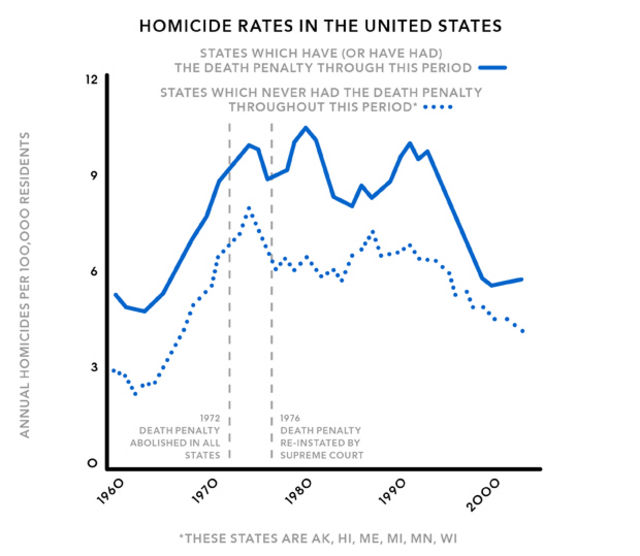
The debate over the death penalty offers a vivid illustration of a tragic flaw in the market of ideas: Strong beliefs attract a lot more attention, and can have a lot more influence, than the truth.

In recent years, five U.S. states have eliminated capital punishment, and several others are currently reconsidering their policies. Advocates of the death penalty insist the moves will lead to more murders. They point to a number of studies conducted over the past couple of decades that purport to find clear evidence supporting their view. Experts happily serve up unequivocal congressional testimony, and feed their analyses to lobby groups.

The reality, unsatisfying and inconvenient as it may be, is that we simply don’t know how capital punishment affects the homicide rate. That’s the conclusion of the National Academy of Sciences, which typically plays the role of impartial arbiter in these social-science debates. Their expert panel recently concluded that existing research “is not informative about whether capital punishment decreases, increases, or has no effect on homicide rates,” and that such studies “should not influence policy judgments about capital punishment.”

More

Read the Paper

See also


Friday, June 8, 2012

Happyism: The creepy new economics of pleasure

by Deirdre N. McCloskey

The New Republic

June 8, 2012

In the first panel of a Peanuts strip—the preceding ones had been about Lucy scolding her little brother, Linus, for not being a good brother—Lucy asks what Linus is offering her: “What’s this?” “A dish of ice cream.” Then Linus explains: “I brought it to you in order that your stay here on Earth might be more pleasant.” She smiles genially, and uncharacteristically: “Well, thank you ... You’re a good brother.” In the final panel, Linus walks away smiling: “Happiness is a compliment from your sister!”

That about sums it up. Pleasure is to be achieved by things like dishes of ice cream. Psychologists have shown rigorously that people are most pleasured exactly as you might have thought if you are a human being: when eating, say, a heaped pastrami on rye at Manny’s Deli off Roosevelt Road in what was once the garment district of Chicago. Happiness, by contrast, is more complicated, though it can also be pursued at Manny’s. It is the pleasure of kosher comfort food, down to the diminishing marginal utility of that last bite—but it is also expressing one’s urban identity and Chicago-ism, even at the costs of the considerable inconvenience in getting to Manny’s and braving the insults of the countermen. It is introducing your friend, a naïve gentile, to the Jewish side of the City of the Big Shoulders, affirming thereby your philo-Semitism. It is participating in the American democracy of a 1950s cafeteria. It is facing, too, the cost of a little addition to the love handles. And it is a compliment from your sister. Pleasure is a brain wave right now. Happiness is a good story of your life. The Greek word for happiness is “eudaimonia,” which means literally “having a good guiding angel,” like Clarence the angel in It’s a Wonderful Life. The schoolbook summary of the Greek idea in Aristotle says that such happiness is “the exercise of vital powers along lines of excellence in a life affording them scope.”

But nowadays there is a new science of happiness, and some of the psychologists and almost all the economists involved want you to think that happiness is just pleasure. Further, they propose to calculate your happiness, by asking you where you fall on a three-point scale, 1-2-3: “not too happy,” “pretty happy,” “very happy.” They then want to move to technical manipulations of the numbers, showing that you, too, can be “happy,” if you will but let the psychologists and the economists show you (and the government) how.

More

Monday, June 4, 2012

Sale of visas: A smuggler’s final song?

by Emmanuelle Auriol and Alice Mesnard

Vox

June 4, 2012

Is there a way of eliminating human smuggling? This column argues it can be done that by legalising migration through the sale of visas at a price that pushes smugglers out of business. The resulting trade-off between eliminating human smuggling and controlling migration flows can be dealt with the right policy mix of traditional repressive instruments and innovative pricing tools.


Each year, an estimated 2,000 people drowned on their migrant’s journey from Africa to Europe (The Economist 2005) and many more on other routes. Not only is crossing borders illegally a dangerous operation but it also entails very high financial costs. For border crossings such as from Mexico to the US, human smugglers can charge up to $4,000, while trans-pacific crossings of Chinese immigrants to the US cost above $35,000 in the mid-90s and have since increased sharply.

With estimated revenues of around $5 billion a year in the US and €4 billion in the EU (Padgett 2003), people smuggling is a lucrative business. Over the years, it has integrated with other types of illegal activities such as drug shipping and prostitution. Led by international criminal organisations they pose a threat to the rule of law in countries of origin, transit, and destination.

Although it is important for policymakers to understand why these illegal activities and their associated criminalities are so prevalent, there are surprisingly few studies on the supply side of illegal migration (noticeable exceptions are Friebel and Guriev, 2006 and Tamura, 2010, as surveyed by Mahmoud and Trebesch 2010). Yet, it is important to study the industrial organisation of human smuggling, notably smugglers’ pricing and supply of services, to explore what type of economic policies can be implemented to fight against them.

More

Capitalism

by Richard A. Posner

The Becker-Posner Blog

June 3, 2012

I agree wholeheartedly with Becker that capitalism is a superior economic system to any other that has been tried, the others being mainly socialism and communism. The best evidence for this is that out of the 194 countries in the world, I can think of only two that are not capitalist—Cuba, which however is moving slowly in the capitalist direction, and North Korea, the greatest economic failure on the planet.

But this statistic indicates that capitalism is a necessary condition of economic success rather than a sufficient condition. Many of the world’s countries, though capitalist, are basket cases—not as badly off as North Korea, but plenty badly off. Per capita incomes in rich capitalist countries such as the United States, Canada, Germany, Britain, and Japan greatly exceed per capita incomes in poor capitalist countries, which are the majority of countries.

So the big question is, given capitalism, what else does a country need in order to prosper? We know that it doesn’t need abundant natural resources or a large population. But it needs a legal and political system that protects property rights, allows a large degree of economic freedom, minimizes corruption, controls harmful externalities (like pollution) and subsidizes beneficial ones (like education), distinguishes between equality of opportunity (which it promotes) and equality of incomes (which it promotes only to the extent of combating poverty), welcomes and assimilates skilled and wealthy immigrants, and (related to protecting economic freedom) avoids public ownership or control of economic enterprises. To create and maintain such a legal and political system a country also requires a culture of respect for business success, of competition and risk-taking, and of consumerism—since, as Keynes argued, consumption drives production.

Such a combination is difficult to achieve; no nation has achieved it. The variance across nations in culture and in institutional structure is very great, and determines the relative economic success of the different nations.

Since there is so much variance across capitalist countries—so much that can go wrong with a capitalist system because of the complex institutional structure and social culture that capitalism requires if it is to be maximally successful in contributing to social welfare—we need to avoid complacency. Complacency was a major factor in the surprising economic collapse that began in September 2008, a collapse the consequences of which are still very much with us.

More

Profits, Competition, and Social Welfare

by Gary S. Becker

The Becker-Posner Blog

June 3, 2012

The financial crisis and the resulting recession have led to a strong reaction in many countries against the profit motive and private enterprise. Left of center political parties are gaining office and power in France, Mexico, Greece, and elsewhere with the promise of much greater regulation of banks and other businesses, renationalizing some companies, and constraining profits through higher taxes and other ways.

It is easy to sympathize with the hostility to the many banks that behaved (in retrospect) so foolishly in ways that damaged everyone else as they took on excessive risk in their quests for greater profits. One can understand also the general reaction against capitalism and “market failures” since commercial and investment banks were in the past a leading example of capitalism at work. Yet anyone concerned about the welfare of the poor and middle classes should resist the temptation to attack competitive private enterprise and capitalism- monopoly or crony capitalism should be deplored. This is only partly because “government failure” also contributed in an important way to the financial crisis as regulators did not rein in the asset explosion of banks and households. Indeed, regulators often encouraged lending to lower income families to buy houses with low down payments, large mortgages and ballooning interest payments.

The main reason to be concerned about the attacks on competitive capitalism is that it has delivered during the past 150 years so much to all strata’s of society, including the poor. I will try to demonstrate this not with a general analysis, but with several rather impressive examples.

China in 1980 was among the poorest countries in the world. It had just gone through the Cultural Revolution and the Great Leap Forward that contributed to the deaths of tens of millions of rural and other Chinese. In desperation, a few farsighted Chinese leaders decided to allow private enterprise and capitalism to gain a toehold in its agricultural sector. To the great surprise of many Chinese political leaders, the result was an explosion in farm output, even though farmers had only tiny plots of land to work with. Seeing the success of the liberalization of farm output, China extended the incentive system to industry by encouraging the growth of private enterprises in some sectors. Again, the results far exceeded expectations as these private companies, many owned by Taiwanese and Hong Kong residents, were not only far more efficient than state owned enterprises, but they also became the leaders in the rapid expansion of exports from China to the US and other countries.

More

Wednesday, May 30, 2012

Unilateral tariff liberalisation

by Richard Baldwin

Vox

May 30, 2012

In the late 1980s, developing nations that had eschewed all forms of liberalisation began to cut their import tariffs unilaterally. This column explains how the communication-technology revolution was the shock that altered the political-economy equilibrium against infant-industry protection and in favour of joining international supply chains which involved tariff liberalisation.


For most of the post-war period, trade liberalisation was slow, involved only rich nations, and occurred only in the context of reciprocal bargains – multilateral GATT Rounds or regional trade agreements.

The reciprocity was critical. Since foreign tariffs would fall only if domestic tariffs did, each nation’s exporters fought against the protectionists within their borders. In this way, governments found it politically optimal to cut tariffs that they had previously found optimal to impose (Moser 1990).1 Developed nations, who played reciprocally in the GATT, lowered their tariffs; developing nations who didn’t play reciprocally in the GATT – due to so-called special and differential treatment for developing nations – did not cut their tariffs.

All this changed in the late 1980s. Developing nations that had previously eschewed all forms of liberalisation began to cut their tariffs unilaterally as seen in Figure 1.

Figure 1. Tariff liberalisation


More

Read the Paper

How Political Clout Made Banks Too Big to Fail

by Luigi Zingales

Bloomberg

May 30, 2012

The U.S. has historically kept the financial sector in check through a combination of sound principles and serendipitous decisions. But as the financial system gained strength in recent years, it also gained political influence. In the last decade, it has become too concentrated and too powerful, which has damaged not only the economy but the financial sector itself.

How did it happen? In 1933, the Glass-Steagall Act erected a wall between two ways that banks could help customers borrow money. The idea was to keep commercial banks from exploiting their depositors, who might get saddled with the bonds of firms that could not repay the money they owed. One beneficial side effect of the Glass-Steagall Act was to fragment the banking sector and reduce the financial industry’s political power. Another was to foster healthy competition between commercial banks and investment banks.

More

Tuesday, May 29, 2012

The Broken Legs of Global Trade

by Jagdish Bhagwati

Project Syndicate

May 29, 2012

The Doha Round, the latest phase of multilateral trade negotiations, failed in November 2011, after ten years of talks, despite official efforts by many countries, including the United Kingdom and Germany, and by nearly all eminent trade scholars today. While trade officials in the United States and the European Union blamed the G-22 developing countries’ excessive demands for the failure of earlier negotiations in Cancún in 2003, there is general agreement that this time it was the US whose unwarranted (and unyielding) demands killed the talks. So, now what?

The failure to achieve multilateral trade liberalization by concluding the Doha Round means that the world lost the gains from trade that a successful treaty would have brought. But that is hardly the end of the matter: the failure of Doha will virtually halt multilateral trade liberalization for years to come.

Of course, multilateral trade negotiations are only one of three legs on which the World Trade Organization stands. But breaking that leg adversely affects the functioning of the other two: the WTO’s rule-making authority and its dispute-settlement mechanism. The costs here may also be large.

More

The on-going debate on natural resources and development

by Erwin Bulte

Vox

May 28, 2012

The so-called resource curse suggests that resource booms are bad for development. One reason put forward is that fighting over resource rents leads to armed conflict. This column argues the evidence identifying resources as a cause of conflicts is weak and that the policy focus should be on institutional reform, rather than on resources per se.


Prices of natural resource commodities have increased a lot in recent years. While the current commodity price index is not as high as it was during its peak in the spring of 2008, commodity prices have increased by 10% over the past 6 months, by 56% over the past 5 years, and by no less than 249% over the past 10 years. For certain specific commodities, price hikes are even larger. In 2002 a single DVD recorder cost as much as a hundred tons of iron ore. The current exchange rate is about one ton of iron ore per DVD recorder.

Several factors explain the reversal of fortune for miners –– conditions have been favourable both on the supply side (e.g., market power in the mining industry) and on the demand side (e.g., economic development in India and China). An important question concerns the degree to which these economic gains trickle down beyond the shareholders of international mining companies. Do high commodity prices translate into enhanced prospects for peaceful economic development for poor resource-exporting countries? This turns out to be a contested issue.

More

Saturday, May 26, 2012

Why We Lie

by Dan Ariely

Wall Street Journal

May 26, 2012

Not too long ago, one of my students, named Peter, told me a story that captures rather nicely our society's misguided efforts to deal with dishonesty. One day, Peter locked himself out of his house. After a spell, the locksmith pulled up in his truck and picked the lock in about a minute.

"I was amazed at how quickly and easily this guy was able to open the door," Peter said. The locksmith told him that locks are on doors only to keep honest people honest. One percent of people will always be honest and never steal. Another 1% will always be dishonest and always try to pick your lock and steal your television; locks won't do much to protect you from the hardened thieves, who can get into your house if they really want to. The purpose of locks, the locksmith said, is to protect you from the 98% of mostly honest people who might be tempted to try your door if it had no lock.

We tend to think that people are either honest or dishonest. In the age of Bernie Madoff and Mark McGwire, James Frey and John Edwards, we like to believe that most people are virtuous, but a few bad apples spoil the bunch. If this were true, society might easily remedy its problems with cheating and dishonesty. Human-resources departments could screen for cheaters when hiring. Dishonest financial advisers or building contractors could be flagged quickly and shunned. Cheaters in sports and other arenas would be easy to spot before they rose to the tops of their professions.

But that is not how dishonesty works. Over the past decade or so, my colleagues and I have taken a close look at why people cheat, using a variety of experiments and looking at a panoply of unique data sets—from insurance claims to employment histories to the treatment records of doctors and dentists. What we have found, in a nutshell: Everybody has the capacity to be dishonest, and almost everybody cheats—just by a little. Except for a few outliers at the top and bottom, the behavior of almost everyone is driven by two opposing motivations. On the one hand, we want to benefit from cheating and get as much money and glory as possible; on the other hand, we want to view ourselves as honest, honorable people. Sadly, it is this kind of small-scale mass cheating, not the high-profile cases, that is most corrosive to society.

More


Thursday, May 24, 2012

Frauds, Swingers and the Odd Early Days of Credit Cards

by Louis Hyman

Bloomberg

May 24, 2012

As credit cards came into greater use in the late 1950s and early ’60s, the financial press closely followed their emergence, especially when the wrong sorts got access to them.

Consider, for example, Joseph Miraglia. In one month of orgiastic spending, Miraglia ran up a $10,000 bill entertaining himself across three countries, four girlfriends and one rhinestone-collared cocker spaniel. Miraglia was no scion: He was a clerk from the Lower East Side of Manhattan earning $73 a week. How did he get into the then-exclusive credit-card club?

In 1959, travel and entertainment charge cards, such as Diners Club, were just beginning to lose their ground to bank cards, such as BankAmericard. But the use of credit was still subject to very real technological and moral constraints. Miraglia nicely illustrated how both would soon change -- and foreshadowed some of the consequences.

His adventure began in September 1959, when he ducked into a fancy New York restaurant and saw a pile of Travel and Entertainment card applications for “men of responsibility.” He filled out the Hilton Hotels’ Carte Blanche paperwork, complete with his real pittance of a salary, and, to his surprise, received a card a few weeks later with a letter that said “this card is your key to every luxury Hilton has to offer.”

More


Let Data, Not Politics, Guide Regulation

by Tobias J. Moskowitz

Bloomberg

May 24, 2012

Several years after the global financial crisis, the fierce debate over regulation continues to be driven by strong beliefs -- largely uninformed ones -- rather than hard facts.

Some believe more regulation is necessary, others that it would cause the downfall of our markets. No one, however, seems to be talking about the evidence for or against regulation.

This is partly because very little evidence exists on the effects of regulation or its efficacy. It is extremely difficult to isolate the impact of any proposed regulatory change from everything else that is occurring simultaneously within financial markets. Studies claiming to analyze those effects are almost always confounded by other factors, such as the environment that led to a given regulation; the response of market participants to regulation or anticipated regulation; the selection of securities targeted for regulation; and the timing of regulation.

To overcome these problems and identify an effect unrelated to other possible effects, it would be useful to run a controlled experiment, as medical research does with clinical trials. Is that feasible in financial markets? My colleagues Steven Kaplan, Berk Sensoy and I recently conducted such an experiment to get a better understanding of one type of financial regulation: bans on short selling certain stocks, a very simple measure that was put in effect worldwide for financial stocks during the crisis.

More

Tuesday, May 22, 2012

Rethinking the ‘war on drugs’: Insights from the US and Mexico

by Ernesto Zedillo

Vox

May 22, 2012

Illegal drugs are one of the planet’s most pressing problems. They shatter hundreds of millions of lives and wreak untold social, economic and political damage in both consuming and producing nations. In this column, ex-President of Mexico Ernesto Zedillo introduces an eBook he edited on the issue that points very strongly in the direction of a serious reconsideration of drug policy.


America’s most loved economics textbook (Mankiw 2012) uses the ‘war on drugs’ to illustrate how restricting supply when demand is inelastic increases the total cash spent on illegal drugs. Every anti-smuggling tactic makes each consignment more profitable. No wonder the US war on drugs is not going so well. Yet despite 40 years of violence, corruption and continuing addiction, the US is in no mood to alter course.

At the Summit of the Americas last month, the Colombian and Guatemalan Presidents called for a new approach. The US flatly rules out any change. Dan Restrepo, the National Security Council's senior director for Latin America, said in a press conference on the summit: “US policy on this is very clear. The President doesn't support decriminalisation, but he does consider this is a legitimate debate. And it's a legitimate debate because it helps to demystify this as an option”. (Rogin 2012)

More

Sunday, May 20, 2012

Trade and inequality: From theory to estimation

by Elhanan Helpman, Oleg Itskhoki, Marc Muendler and Stephen Redding

Vox

May 20, 2012

What is the effect of trade on inequality? This column presents a unique study examining wage inequality in Brazil after liberalisation. Starting from a closed economy, the column finds that wage inequality will initially rise as only some firms take advantage of the new opportunities. But as trade costs continue to fall and more firms start to trade, wage inequality peaks and begins to fall back.


Until recently, research on the labour market effects of international trade has been heavily influenced by traditional theories such as the Heckscher-Ohlin and Specific Factors models. Those theories provide predictions about relative wages across skill groups or across occupations and sectors. In contrast to predictions of those theories, empirical studies find increased wage inequality in both developed and developing countries, growing residual wage dispersion among workers with similar observed characteristics, and increased wage dispersion across plants and firms within sectors. In a large part due to this disconnect, previous studies have concluded that the contribution of international trade to growing wage inequality is modest at best (see for example the survey by Goldberg and Pavcnik 2007).

We argue that these apparently discordant empirical findings are in fact consistent with a trade-based explanation for wage inequality, but one rooted in recent models of firm heterogeneity and trade. In Helpman et al. (2012) we begin by documenting a number of stylised facts about the level and growth of wage inequality in Brazil that provide support for these recent theories.
  • First, much of overall wage inequality occurs within sectors and occupations rather than between sectors and occupations. We document this fact with a decomposition of the variance of the log wage into the variance within sector-occupations and the variance between sector-occupations. We find that the within sector-occupation component of wage inequality accounts for over two-thirds of both the level and growth of wage inequality in Brazil between 1986 and 1995, as illustrated for the growth of wage inequality in Figure 1.
  • Second, a large share of the wage inequality within sectors and occupations is driven by wage inequality between rather than within firms.
  • Third, both prior findings are robust to controlling for observed worker characteristics. This robustness suggests that wage inequality between firms within sector-occupations is largely residual wage inequality.
More

Read the Paper

Friday, May 18, 2012

On work hours in the US and Europe

by Indraneel Chakraborty, Hans Holter and Serhiy Stepanchuk

Vox

May 18, 2012

It is no secret that Americans work more than Europeans – 30% more according to recent studies. Many economists point to higher taxes in Europe as a major cause. This column suggests that divorce rates also play a role, particularly for women's labour supply.

According to recent research, Americans work 30% more than Europeans (Prescott 2004 and Rogerson 2006). This was not the case in early 1970s when Western Europeans worked more than Americans. What accounts for the large differences between countries today? Our study finds that divorce rates and tax rates together on average explain 58% of the difference in terms of hours worked between the US and 17 European countries.

Our research starts by trying to uncover the determinants of cross-country differences in work hours through analysing the hours worked by different demographic subgroups (Chakraborty et al. 2012). We find that women are typically the largest contributors to the aggregate differences. European women work less than American women, irrespective of whether we look at single or married women, or women with and without children.

Cross-country variation in tax systems is one of the most popular proposed explanations for the observed discrepancy in work hours between the US and Europe. The basic intuition here is straightforward – higher labour income taxes reduce the incentives to work. However, for the 18 countries in our sample, we find that, while there is indeed a negative correlation between various measures of taxation and hours worked by men, the corresponding correlation for women is close to 0. Figure 1 below plots the correlation between male and female labour supply and the "average effective tax rate", a measure that combines the average labour income tax and consumption tax in each country into a single tax rate.

Figure 1. Tax rates and labour supply by gender


More

Thursday, May 17, 2012

What Makes Countries Rich or Poor?

by Jared Diamond

New York Review of Books

June 7, 2012

The fence that divides the city of Nogales is part of a natural experiment in organizing human societies. North of the fence lies the American city of Nogales, Arizona; south of it lies the Mexican city of Nogales, Sonora. On the American side, average income and life expectancy are higher, crime and corruption are lower, health and roads are better, and elections are more democratic. Yet the geographic environment is identical on both sides of the fence, and the ethnic makeup of the human population is similar. The reasons for those differences between the two Nogaleses are the differences between the current political and economic institutions of the US and Mexico.

This example, which introduces Why Nations Fail by Daron Acemoglu and James Robinson, illustrates on a small scale the book’s subject.* Power, prosperity, and poverty vary greatly around the world. Norway, the world’s richest country, is 496 times richer than Burundi, the world’s poorest country (average per capita incomes $84,290 and $170 respectively, according to the World Bank). Why? That’s a central question of economics.

Different economists have different views about the relative importance of the conditions and factors that make countries richer or poorer. The factors they most discuss are so-called “good institutions,” which may be defined as laws and practices that motivate people to work hard, become economically productive, and thereby enrich both themselves and their countries. They are the basis of the Nogales anecdote, and the focus of Why Nations Fail. In the authors’ words:
The reason that Nogales, Arizona, is much richer than Nogales, Sonora, is simple: it is because of the very different institutions on the two sides of the border, which create very different incentives for the inhabitants of Nogales, Arizona, versus Nogales, Sonora.
Among the good economic institutions that motivate people to become productive are the protection of their private property rights, predictable enforcement of their contracts, opportunities to invest and retain control of their money, control of inflation, and open exchange of currency. For instance, people are motivated to work hard if they have opportunities to invest their earnings profitably, but not if they have few such opportunities or if their earnings or profits are likely to be confiscated.

The strongest evidence supporting this view comes from natural experiments involving borders: i.e., division of a uniform environment and initially uniform human population by a political border that eventually comes to separate different economic and political institutions, which create differences in wealth. Besides Nogales, examples include the contrasts between North and South Korea and between the former East and West Germany. Many or most economists, including Acemoglu and Robinson, generalize from these examples of bordering countries and deduce that good institutions also explain the differences in wealth between nations that aren’t neighbors and that differ greatly in their geographic environments and human populations.

More

Sunday, May 13, 2012

Origins of the Sicilian Mafia

by Arcangelo Dimico, Alessia Isopi and Ola Olsson

Vox

May 13, 2012

If it were a business, the Mafia would be one of Italy’s most successful and one of the largest in Europe. But how did it come to be so powerful? This column argues that it began with control of the international lemon trade in the 19th century.


The Italian Mafia can be seen as one of the largest and most successful businesses in Italy. In one of the latest reports from the Italian Minister of Home Affairs, it has been estimated that revenues from just the informal sector related to the Mafia amount to almost €180 billion. In terms of GDP, revenues from Mafia-related businesses represent almost 12% of the total Italian GDP and are equal to the sum of the GDPs of Estonia, Croatia, Romania, and Slovenia (Ruffolo et al. 2010). To date, the Italian Mafia is the most successful form of organised crime in Europe and comparable to the Chinese, Japanese, Russian, and South American crime organisations in terms of business.

Given the economic and social relevance of the issue, it is natural to wonder why these forms of organised crime develop and what factors explain the cross-regional variation of Mafia. Both institutional and historical explanations have been proposed in the literature. Fiorentini (1999), Grossman (1995), and Skaperdas (2001) focus on weak institutions, predation, and enforcement of property rights. On the other hand, with regard to the Sicilian Mafia, Villari (1875), Sonnino and Franchetti (1877) and Colajani (1885) focus on the legacy of feudalism, the development of latifundism and a loss of social capital and public trust.

Even though the above literature provides plausible explanations for the origin of organised crime, it is still difficult to understand why we observe a huge variation across regions experiencing very similar conditions. Organised forms of crime normally appear only in a small number of localities and then expand through the entire region. It is therefore important to understand what is specific to these few localities where the Mafia appears.

More

Read the Paper

Wednesday, May 9, 2012

Giving the Well-Performing State Its Due

by Ana Palacio

Project Syndicate

May 9, 2012

The triumph of democracy and market-based economics – the End of History, as the American political philosopher Francis Fukuyama famously called it – which was proclaimed to be inevitable with the fall of the Berlin Wall, soon proved to be little more than a mirage. However, following China’s intellectual pirouette to maintain one-party rule while embracing the capitalist credo, history’s interpreters shifted their focus to the economy: not everybody would be free and elect their government, but capitalist prosperity would hold sway worldwide.

Now, however, the economic tumult shaking Europe, the erosion of the middle class in the West, and the growing social inequalities worldwide are undermining capitalism’s claim to universal triumph. Hard questions are being asked: Is capitalism as we know it doomed? Is the market no longer able to generate prosperity? Is China’s brand of state capitalism an alternative and potentially victorious paradigm?

The pervasive soul-searching prompted by such questions has nurtured a growing recognition that capitalism’s success depends not only on macroeconomic policy or economic indicators. It rests on a bedrock of good governance and the rule of law – in other words, a well-performing state. The West overlooked the fundamental importance of this while it was fighting communism.

More

Tuesday, May 8, 2012

Facebook’s Organ Donation Success Needs Follow-Up

by Sally Satel

Bloomberg

May 8, 2012

Facebook Inc. took a momentous action last week. And I don’t mean its announced intention to sell shares for $28 to $35 in an initial public offering later this month.

Of more importance to at least one segment of the population was the company’s invitation to users to register to become organ donors. Forty-eight hours later, more than 100,000 people had indicated, on Facebook Timeline, their wish to be a donor when they die.

As a result, online state donor registries experienced a remarkable 23-fold surge, according to Donate Life America, a nonprofit alliance of national donor advocate organizations.

Better yet, a week later, the traffic was sustained. Typically, Web-based promotions lead to a spike of interest that dissipates within hours.

For the 114,000 people waiting for a kidney, liver, heart or lung -- 7,000 to 10,000 of whom die each year -- Facebook has performed a great public-health service. For more than two decades, advocates have been urging people to sign up as donors when they renew their driver’s license, yet only about 43 percent have done so. Facebook has made registering much easier.

And although this impressive achievement won’t be enough to fill the great demand for transplantable organs, it may also help show the way forward to encourage live donations.

More

Friday, March 30, 2012

Consumer Protection Bureau Can Teach Financial Self-Help

by Robert H. Gertner

Bloomberg

March 29, 2012

The long gestation of the Consumer Financial Protection Bureau, which was mandated by the Dodd- Frank Act, is over.

Now that the bureau’s chairman, Richard Cordray, is in place and it is rolling out programs, it is a good time to think about how government intervention can improve outcomes in the financial products consumers buy. Regardless of whether one prefers caveat emptor, a paternalistic federal government or something in between, the CFPB is a reality. Improving financial decisions by consumers is a worthy goal, but it will not be easy to design effective government actions to help them do so.

When consumers make poor financial decisions, they often do so because they lack information and understanding of product features. Financial literacy and sophistication is shockingly low: About one-third of the U.S. population understands the concepts of compound interest or how credit-card debt works. Such financial illiteracy is correlated with high levels of debt and high fees for financial services, and is greater among people with low incomes and low education, as well as minorities and the elderly.

More

Wednesday, March 21, 2012

Το Θεώρημα του Coase και η Οικονομική Ανάλυση του Δικαίου

του Αριστείδη Χατζή

Υπό δημοσίευση στο συλλογικό τόμο Ο Ρόλος της Δικαιοσύνης στην Άσκηση της Επιχειρηματικής Δραστηριότητας, Επιμέλεια: Πόπη Καλαμπούκα-Γιαννοπούλου. Αθήνα: Νομική Βιβλιοθήκη, 2012

[Κατεβάστε ολόκληρο το κείμενο σε PDF]

Πρόλογος

Μέχρι τα μέσα του περασμένου αιώνα οι οικονομολόγοι αντιμετώπιζαν το δίκαιο αλλά και ευρύτερα τους θεσμούς ως μέρος των περιορισμών (constraints) που οριοθετούν τις ανθρώπινες επιλογές. Για την πρώιμη νεοκλασική οικονομική θεωρία οι κανόνες δικαίου αποτελούσαν εμπόδια στην προσπάθεια των ορθολογικών ατόμων να μεγιστοποιήσουν την ωφελιμότητά τους, δηλαδή να επιτύχουν μεγαλύτερα επίπεδα ατομικής ευημερίας. Αυτό δεν σημαίνει ότι οι οικονομολόγοι θεωρούσαν άχρηστο το δίκαιο – κάθε άλλο. Είχαν από νωρίς αναγνωρίσει την κεντρική σημασία του κράτους δικαίου για την οικονομική ευημερία και ανάπτυξη: η προστασία των δικαιωμάτων ιδιοκτησίας, η εφαρμογή των συμβάσεων, η εξασφάλιση της κοινωνικής ομαλότητας και συνοχής αλλά και η κοινωνική πολιτική απαιτούσαν ένα πλέγμα κανόνων δικαίου που θεωρούνταν απαραίτητα μεν αλλά ταυτόχρονα και περιοριστικά της οικονομικής δραστηριότητας. Για τους οικονομολόγους αυτοί οι κανόνες (τυπικοί και άτυποι) περιόριζαν τις εφικτές επιλογές όπως οι φυσικοί περιορισμοί (ο χρόνος) ή το εισόδημα. Έτσι δεν αποτελούσαν αντικείμενο της οικονομικής επιστήμης – μελετούνταν παρεμπιπτόντως και αντιμετωπίζονταν όπως οι προτιμήσεις – θεωρούνταν δηλαδή δεδομένοι και εξωγενείς.

Αυτός που κατόρθωσε να αλλάξει ριζικά τον τρόπο που οι οικονομολόγοι αντιμετωπίζουν το δίκαιο και τους θεσμούς ήταν ο άγγλος οικονομολόγος Ronald H. Coase. Με την συμβολή του στην οικονομική θεωρία (η οποία τιμήθηκε με το Βραβείο Νόμπελ στην Οικονομική Επιστήμη το 1991) ανάγκασε τους οικονομολόγους να δουν το δίκαιο και τους θεσμούς με πολύ διαφορετικό τρόπο: όχι ως περιορισμούς αλλά ως εργαλεία επίλυσης των ενδογενών προβλημάτων της αγοράς. Ταυτόχρονα το θεώρημα του Coase (όπως κωδικοποιήθηκε η βασική συνεισφορά του στην οικονομική επιστήμη από τον George Stigler) αποτέλεσε τη θεμέλια λίθο της οικονομικής ανάλυσης του δικαίου, της πλέον επιτυχημένης διεπιστημονικής προσέγγισης στο δικαιικό φαινόμενο. Ο Coase υποχρέωσε με το έργο του και τους νομικούς να αντιληφθούν ότι δεν μπορούν να ρυθμίσουν την αγορά (αλλά και την κοινωνία) χωρίς τη βοήθεια μιας εμπειρικής κοινωνικής επιστήμης, όπως τα οικονομικά, που θα τους βοηθήσουν να διαμορφώσουν αποτελεσματικούς θεσμούς.

Στο κείμενο που ακολουθεί θα παρουσιάσουμε αναλυτικά το θεώρημα του Coase και στις δύο εκδοχές του (την θετική/περιγραφική και την κανονιστική), το πρόβλημα του κόστους συναλλαγών, τη γέννηση της οικονομικής ανάλυσης του δικαίου από τον Richard Posner και τη συνεισφορά στη συζήτηση για τις μορφές προστασίας των δικαιωμάτων από τον Guido Calabresi. Θα ολοκληρώσουμε τη μελέτη μας με την ελληνική περίπτωση που έχει ιδιαίτερο ενδιαφέρον καθώς η Ελλάδα αποτελεί κυριολεκτικά παράδεισο κόστους συναλλαγών που καθιστούν απαγορευτική την οικονομική ανάπτυξη, τη μόνη έξοδο από την κρίση.

Για τη συνέχεια του κειμένου πατήστε τον παρακάτω σύνδεσμο:

Κατεβάστε ολόκληρο το κείμενο σε PDF

Tuesday, March 13, 2012

Έρευνα: Πόσο εύκολη είναι η μεταφορά του λογαριασμού μας σε άλλη τράπεζα

Κέντρο Προστασίας Καταναλωτών (ΚΕ.Π.ΚΑ.)
13 Μαρτίου 2012

Από την 1η Νοεμβρίου 2009, είναι ευκολότερη, για τους καταναλωτές, η μεταφορά του προσωπικού τρεχούμενου λογαριασμού τους και του ατομικού λογαριασμού ταμιευτηρίου τους, από μια τράπεζα, σε άλλη, στην Ελλάδα. Η προσπάθεια αυτή ξεκίνησε, σε ευρωπαϊκό επίπεδο και το ΚΕ.Π.ΚΑ., από την πρώτη στιγμή, έδωσε, δυναμικά, το παρόν και στην Ευρώπη και στην Ελλάδα, για να διαμορφωθούν όροι και διαδικασίες φιλικές, για τους καταναλωτές.

Σήμερα, λοιπόν, για κάθε καταναλωτή, που επιθυμεί να μεταφέρει είτε τον προσωπικό τρεχούμενο λογαριασμό του, είτε τον ατομικό λογαριασμό ταμιευτηρίου του, σε άλλη τράπεζα, η νέα τράπεζα λειτουργεί, ως το κύριο σημείο επαφής και προσφέρει τη συνδρομή της, σε όλη τη διάρκεια της διαδικασίας μεταφοράς. Έρχεται, σε συνεννόηση, με την παλαιά τράπεζα, διασφαλίζοντας ότι η μεταφορά των επαναλαμβανόμενων πληρωμών του καταναλωτή, όπως τυχόν άμεσες χρεώσεις και πάγιες εντολές, διενεργούνται ομαλά, απλά και γρήγορα. Τέλος, η νέα τράπεζα βοηθά τον καταναλωτή, στο κλείσιμο του παλαιού λογαριασμού και στη μεταφορά του υπολοίπου, στο νέο λογαριασμό.

Όλα τα παραπάνω αποτελούν υποχρεώσεις των τραπεζών, που απορρέουν, από τις «Κοινές Αρχές σχετικά με τη μεταφορά τραπεζικών λογαριασμών», οι οποίες αποτελούν ένα Κώδικα Δεοντολογίας, στον οποίο έχουν προσχωρήσει, εθελοντικά, σχεδόν όλες οι τράπεζες. Η προσχώρηση αυτή σημαίνει ότι οι Κοινές Αρχές εφαρμόζονται, υποχρεωτικά, από τις τράπεζες, που τις έχουν προσυπογράψει.

Το ΚΕ.Π.ΚΑ.-Κέντρο Προστασίας Καταναλωτών θέλησε να διαπιστώσει, αν οι τράπεζες εφαρμόζουν, στην πράξη, αν δηλαδή, ανταποκρίνονται, στις υποχρεώσεις τους, που πηγάζουν, από τις Κοινές Αρχές. Για το λόγο αυτό, διενεργήσαμε μια έρευνα. Η έρευνα διενεργήθηκε, στα πλαίσια της Παγκόσμιας Ημέρας Καταναλωτή. Το ΚΕ.Π.ΚΑ. πιστεύει ότι η 15 του Μάρτη δεν αποτελεί επέτειο, στην οποία θυμόμαστε ότι οι καταναλωτές έχουμε δικαιώματα. Τα δικαιώματά μας ισχύουν 365 μέρες το χρόνο, 24 ώρες το 24ωρο. Έτσι, αποφασίσαμε να κάνουμε έρευνες, για να εξακριβώσουμε αν η αγορά λειτουργεί, σωστά και αν οι επιχειρήσεις εφαρμόζουν τη νομοθεσία και σέβονται τα δικαιώματά μας. Φέτος, θελήσαμε να ελέγξουμε κατά πόσο οι καταναλωτές, στην Ελλάδα, μπορούν να αλλάξουν τράπεζα, γεγονός που αποτελεί αναφαίρετο δικαίωμά μας.

Στην έρευνα, που κάναμε, συμμετείχαν 146 καταναλωτές, από όλη την Ελλάδα. Η έρευνα πραγματοποιήθηκε το χρονικό διάστημα 9/2/2012-7/3/2012, μέσω ερωτηματολόγιου, που αναρτήθηκε, στην ιστοσελίδα του ΚΕ.Π.ΚΑ. και εκτυπώθηκε, για όσους δεν είχαν πρόσβαση, στο internet. 33% των ερωτηματολογίων συμπληρώθηκαν, ηλεκτρονικά και 67% συμπληρώθηκαν, γραπτώς.

Περισσότερα

Monday, March 5, 2012

New Marriages or No Marriages?

by Nancy Folbre

New York Times

March 5, 2012

Motherhood without marriage is on the increase in the United States, particularly among women under 30 who have not completed college. One big question is why.

Some conservatives, like Rick Santorum, blame feminism for encouraging women to work outside the home. Others, like Charles Murray, emphasize the corrupting effect of public assistance. Many liberals, like Thomas Edsall, assert that this story leaves out the effects of deindustrialization and growing economic dislocation, which have reduced the number of marriageable men.

What I see is a culturally contested adjustment to the changing role of women, an adjustment impeded by growing income inequality but eased by education.

As the empirical trajectory unfolds, it becomes easier to assess these competing explanations. Once literally described as a “pathology” of the black community, nonmarital births reached about 29 percent of the total for whites in 2009.

Public assistance can’t take the blame. The trend extends well beyond women eligible for Temporary Assistance to Needy Families or the Earned Income Tax Credit. Strict new work requirements, paternity tests and child support enforcement policies introduced in 1996 have not significantly increased marriage among low-income families. Nor did the federally financed Healthy Marriage Initiative have a discernible effect.

The loss of manufacturing jobs and declining real wages for non-college-educated men help explain why many feel they can’t support a family. Women’s higher employment levels and increased earnings relative to men help explain why many feel they can afford to go it alone.

More

Saturday, February 25, 2012

Moral Hazard: A Tempest-Tossed Idea

by Shaila Dewan

New York Times

February 25, 2012

The reports outraged America: In the wake of Hurricane Katrina, people who fled the ravaged Gulf Coast were spending disaster relief, paid for by taxpayers, on tattoos, $800 handbags and trips to topless bars.

It turned out that few, if any, Katrina evacuees actually did any such thing. A vast majority used debit cards issued by FEMA to buy necessities like food and clothing. But the damage was done: FEMA swore that it would never hand out money like that again.

Behind this brouhaha was an idea that Americans seem particularly preoccupied with. It is called “moral hazard” — an obscure insurance term that has taken on new currency in our troubled economy. We’ve heard a lot about moral hazard lately, first in connection with the bailouts for big banks, and now with efforts to help homeowners who got in over their heads.

Moral hazard sounds like the name of a video game set in a bordello, but in economic terms it refers to the undue risks that people are apt to take if they don’t have to bear the consequences. In other words, if the money is free, why not spend it on a designer purse? If you know that you’ll be bailed out, why not roll the dice on some tricky mortgage investments — or splurge on a home that you can’t really afford?

Moral hazard became part of the national conversation in the financial crisis of 2008, when ordinary Americans wondered why they should rescue banks that helped drive the economy off a cliff. Now those same banks point to moral hazard to explain why they can’t do more to help people with mortgages. And it’s not just banks — the Tea Party movement was inspired by outrage over a government plan to, as Rick Santelli put it in a famous rant on CNBC, “subsidize the losers’ mortgages.”

The cherished American ideal of self-reliance has a flip side: discomfort with the idea of bailouts and safety nets. The notion that even a small portion of such aid might find its way to the undeserving can be enough to scuttle support, or restrict help so drastically that few can use it. The specter of moral hazard haunts a basic tension in American life: to what extent are people responsible for their own problems? The more trouble you’re in, moral hazard suggests, the less we should help.

More